
How a 15-minute "documentary" interview revealed the hidden triggers, true competitors, and winning value proposition for an AI startup.
As founders, we're obsessed with our product. We live and breathe its features, its roadmap, and its potential. But here's a hard truth, famously articulated by Peter Drucker: "People rarely buy what your company thinks it's selling."
Your customers don't buy your AI-powered algorithm; they buy the promotion they get from the results it generates. They don't buy your SaaS platform; they buy the relief of finally having a process that doesn't break.
Understanding this distinction is one of the most important activities a startup can undertake. It's the difference between building a product that's a "nice-to-have" and one that becomes indispensable.
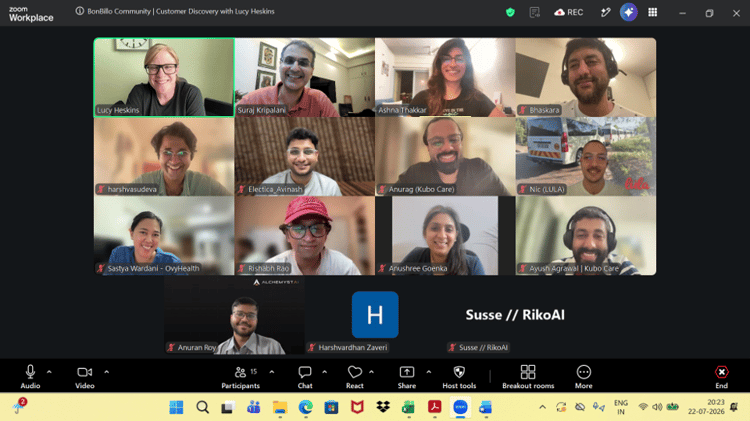
At BonBillo, we recently hosted a workshop with the brilliant Lucy Heskins, Founder of Oh Blimey, on this very topic: Customer Discovery. Lucy showed us how it's done by conducting a live, unscripted customer interview with Harsh, a founder from our community. In just 15 minutes, she masterfully peeled back the layers of a recent purchase decision, uncovering the real motivations, hidden anxieties, and the ultimate "job" the product was hired to do. This wasn't a sales call; it was a documentary. And the insights were pure gold.
This blog post deconstructs that live interview, offering a play-by-play analysis that you can apply to your own customer conversations. Let's dive in.
The Framework: The "Jobs to be Done" Buying Journey
Before we get to the interview, it's crucial to understand the framework Lucy uses: Jobs to be Done (JTBD). The core idea, pioneered by the late Clayton Christensen, is that customers "hire" products to make progress in their lives. Your job as a founder is to understand the "job" your product is being hired for.
This "hiring" process follows a predictable timeline, which Lucy’s interview method is designed to retrace step-by-step. It’s about uncovering the story behind the purchase.
The Live Interview: A Play-by-Play Deconstruction
The setup: Lucy interviews Harsh, a founder whose team recently purchased a team plan for Claude Code, an AI coding tool. Here’s how she uncovered the real story, one question at a time.
Phase 1: Setting the Stage (The Documentary Frame)
Right from the start, Lucy sets a crucial frame. She's not there to sell or validate. She's there to learn. This simple framing is a game-changer. It gives her permission to be curious, to ask repetitive questions, and to dig deeper without making the interviewee feel interrogated. It shifts the dynamic from a transaction to a story.
|
Lucy's Question |
The Insight |
|
"Think about it as though I'm filming a documentary about the day that you suddenly woke up and realized, 'I'm going to buy Claude Code.'" |
This isn't an interview; it's a story. This framing invites a narrative, not just answers. It gives Lucy the license to ask "But what happened next?" or "Can you tell me more about that moment?" to fill in the gaps in the story. |
Phase 2: Uncovering Goals & The "Jobs to be Done"
Lucy's initial questions weren't about Claude Code at all. They were about Harsh. To understand why someone "hires" a product, you first need to understand their world, their pressures, and their goals. This provides the context for the entire purchase decision.
|
Theme & Rationale |
Lucy’s Question |
Harsh’s Answer |
Hidden Insight |
|
Icebreaker & Goals: Builds rapport and uncovers underlying motivations. |
"Can you tell me what you do... and what are your top priorities in your business?" |
"Number one priority is to help us build a product which is of a global grade standard... The second point would be setting up the distribution channel." |
Harsh isn't just buying a coding tool. He's "hiring" something to help him achieve speed and efficiency to build a world-class product and validate ideas faster. This is his core "job to be done." |
Phase 3: Digging for the Trigger Event (The Real Pain)
This is where the interview struck gold. The reason Harsh's team needed a new tool wasn't a vague desire for "better AI." It was a specific, painful bottleneck with their old AI coding tool. This is the trigger event - the moment the pain of the old way becomes greater than the pain of switching.
|
Theme & Rationale |
Lucy’s Question |
Harsh’s Answer |
Hidden Insight |
|
Pains with Old Solution & Trigger Event: Identifies pain points and the emotional trigger that pushed them to act. |
"Do you remember the first time when you realized that your AI coding tool wasn’t doing the job you needed it to?" |
"The major problem was a technical challenge... having multiple developers collaborate on multiple branches. Everyone had to stick to one branch... it was a bottleneck. It was slowing us down." |
The trigger wasn't a feature comparison; it was an operational crisis. The team's productivity was being hampered. This is the real pain your marketing should speak to, not just your solution's features. |
Phase 4: Mapping the Consideration Set & The Catalysts
The journey from problem to purchase is rarely a straight line. It's a series of nudges, or "catalysts." Lucy's questioning uncovered the alternative solutions considered and the critical events that pushed the team forward.
|
Theme & Rationale |
Lucy’s Question |
Harsh’s Answer |
Hidden Insight |
|
Alternative Solutions & Decision-Making Unit: Reveals the competitive landscape and key influencers. |
"You'd mentioned other coding tools that you'd tried. Did they come after your initial AI coding tool?" |
"Yes, they did. We evaluated those options... they were fine, but better for really technical people... people from the product side, that was not as comfortable." |
The "real" competitors aren't just direct alternatives. They include tools that only solve part of the problem or serve only part of the team. The need for a tool that worked for both technical and non-technical staff was a key decision driver. |
|
Catalyst to Purchase: Uncovers the final nudge that forces a decision. |
"When did you start purchasing it?" |
"We overused the free plan to an extent, where we then needed to buy the team plan..." |
This is a powerful product-led growth insight. The product became so indispensable in its free version that hitting a usage limit was the final catalyst. Paying was the logical next step to avoid disruption. |
Phase 5: Nailing the Winning Value Proposition (The "Aha!" Moment)
Towards the end, Lucy asks the million-dollar question. Harsh's initial answer was "Speed and output quality." But the real story, the one that truly sells the value, came out as he elaborated. It wasn't an abstract concept; it was a tangible, almost magical outcome.
|
Theme & Rationale |
Lucy’s Question |
Harsh’s Answer |
Hidden Insight |
|
Identify Winning Value Proposition: Captures the core benefit in the customer's own words. |
"If you had to narrow it down, what was the number one reason why you decided to buy Claude code for your team?" |
"It was able to, like, reverse compute the formula for... stock valuation for us, which was huge... we had a huge bottleneck on a certain ERP developer... It was like overnight we were able to achieve that." |
This is the winning story. Not "speed," but "solving a huge ERP bottleneck overnight." This is the tangible, emotional outcome that should be on the landing page. It's the story that sells. |
Key Lessons from the Interview Debrief
After the mock interview, our founder community shared their takeaways, which were just as insightful as the interview itself.
Key Takeaways for Founders
- The Power of Repetition: As one founder, Ayush, noted, "We were asking the same question in different ways." This isn't a mistake; it's a technique. Asking "How did you find out about it?" and later "Who was the one that instigated it?" can peel back different layers of the same event, revealing the difference between a LinkedIn post (awareness) and a CTO's recommendation (influence).
- Discovery Mode vs. Sales Mode: Another founder, Bhaskara, admitted, "That's a very difficult shift, actually... it's always been sales mode." This is a common struggle. But the insights you gain in discovery mode - understanding the real pain, the true competitors, the buying triggers - are what make your sales efforts 10x more effective.
- Your Real Competitors Aren't Who You Think: The interview revealed that Claude Code wasn't just competing with other AI tools. It was also competing against the status quo and inefficiency (the ERP bottleneck). Understanding this broad competitive landscape is critical for effective positioning.
Putting It All Together: Your Call to Action
Customer discovery is one of the most powerful, highest-leverage activities an early-stage startup can do. It informs your product roadmap, your marketing messaging, your sales strategy, and your overall vision.
Stop pitching and start listening. Frame your conversations as a documentary. Dig for the trigger events, map the buying journey, and uncover the real "job" your customers are hiring your product to do. The answers will not only surprise you - they will give you the clarity you need to build a company that truly matters.