

Founders often spend months building products, talking to customers, refining operations, and trying to gain traction, only to discover that their messaging still feels fuzzy. The product may be real. Revenue may have started. Customer interest may be growing. But when it is time to explain why the startup matters, who it is really for, and why it wins, many teams still sound broader than they should and less differentiated than they need to be.
That was the heart of Elaine Chen’s recent workshop for the BonBillo community on Value Proposition and Strategic Positioning. The session focused on a challenge that shows up repeatedly for startups: translating real customer insight into a sharper value proposition, and a more compelling positioning for growth and fundraising.
For founders, this topic matters because strong startups do not just build useful products. They build a message that helps customers, investors, partners, and team members understand exactly what problem they solve, for whom, and why their approach is meaningfully different.
In the workshop, founders from India, Southeast Asia, and Africa explored practical frameworks for customer focus and competitive positioning. Teams such as Riko AI, Freight Tiger, OvyHealth, LULA, Crafters Wealth, Sparky AI, Kubo Care, Orbit Wallet, and Alchemyst AI all surfaced a common truth: clarity is not a branding exercise at the end. It is a growth tool.
Why this matters more than founders think
Many early-stage startups describe themselves in terms of features, technology, or ambition. But customers rarely buy because a company has a dashboard, an AI engine, a marketplace model, or a workflow layer. They buy because they have a job to get done, a risk to reduce, a cost to control, a result to achieve, or a frustration they are tired of tolerating.
That is why strategic clarity matters so much. When your value proposition is vague:
- Sales conversations take longer
- Marketing feels generic
- Fundraising narratives become harder to support
- Product priorities get scattered
- Different customer segments pull the company in different directions
By contrast, when your positioning is clear, teams make better decisions. They know which customer to prioritize first. They know which pain point should lead the conversation. They know which alternatives they are really competing against. They know what to say no to.
The first discipline: Choose a beachhead customer
One of the most important lessons from the session was that startups must go deep before they go broad.
This sounds simple, but it is one of the hardest choices for founders to make. Many startups see several plausible customer segments. Each one looks attractive. Each one could, in theory, use the product. But those segments often have different motivations, willingness to pay, sales cycles, and messaging needs.
If a startup tries to speak to all of them at once, the positioning becomes diluted.
Elaine repeatedly brought the conversation back to beachhead focus: start with one cohesive segment where the problem is urgent, the customer language is clear, and the path to traction is strongest.
This came up in several examples from the workshop:
- Sparky AI needed to prioritise between audiences such as professionals and homemakers, because the go-to-market motions may be different.
- Kubo Care had to think carefully about how messaging changes across operational, clinical, and financial stakeholders.
- Riko AI needed to define which customer pains were most frequent and highest priority for specific SMB profiles.
- LULA had to clarify which business buyers felt the employee transport problem most acutely and under what conditions.
For early-stage startups, this is a critical reminder: your first positioning does not need to cover your entire future market. It needs to win with your first meaningful segment.
Even in B2B, you are still selling to humans
Another strong theme from the workshop was the importance of mapping personas carefully. In B2B startups especially, founders often oversimplify the buyer as “the company.” But companies do not buy products. People inside companies do.
That means founders should identify:
- the economic buyer
- the end user
- the internal champion
- the influencer
- the person with veto power
- the compliance or risk stakeholder
These roles do not always care about the same things.
A CFO may care about cost control, reporting, and risk reduction.
An operations leader may care about reliability and fewer daily escalations.
An HR leader may care about employee safety and retention.
An end user may care about ease, speed, and trust.
If you collapse all stakeholder needs into one generic message, you lose the nuance that makes the value proposition credible.
The Value Proposition Canvas: Move beyond features
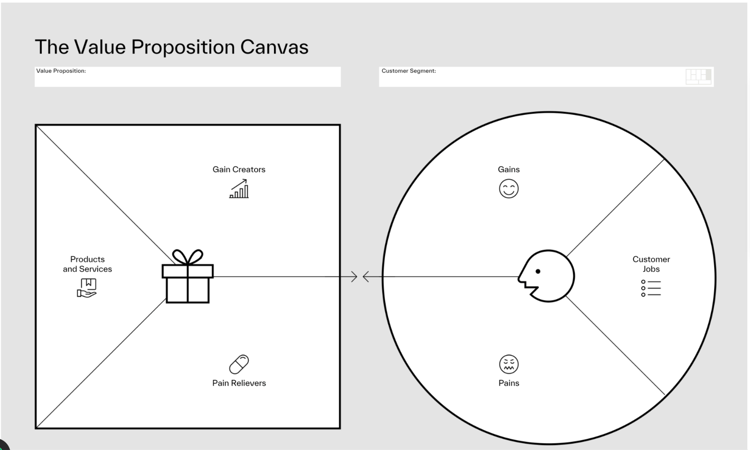
A key framework in the workshop was the Strategizer Value Proposition Canvas, which pushes founders to build from the customer side first. The Strategyzer Value Proposition Canvas has two halves: a circle on the right for the customer, a square on the left for your offering.
You read it right to left. Customer first, solution second. The canvas is deliberately built to stop you doing what every founder wants to do, which is start from the product you have already built and work backwards to a customer who might want it.
The second design feature is pairing. As Elaine put it, you can't cheat, because things come in pairs. Every pain must have a pain reliever facing it. Every gain creator must have a gain. An unpaired sticky note is a finding: either a customer problem you don't solve, or a feature nobody asked for.
The order Elaine teaches
- Pick the segment first. The canvas is close to impossible to fill in if you haven't. If your sticky notes describe wildly different people, that is not a canvas problem - it is a signal you have not chosen your beachhead market.
- Jobs to be done. What is this person trying to get done? In B2B this is almost always tied to their actual job description.
- Pains. What goes wrong, what they fear, what they get blamed for.
- Pain relievers. How you take each specific pain away.
- Products and services. Only now does your feature set enter.
- Gain creators, then gains. What your product makes newly possible, and the outcome the customer actually wants.
The important insight Elaine emphasized was this: pain relievers and gain creators are not just features. That distinction matters.
A feature is something your product has.
A pain reliever is how that feature reduces a meaningful problem.
A gain creator is how your solution helps the customer achieve a desired outcome.
Founders often mistake functionality for value. Customers do not inherently care that your platform has tracking, dashboards, automation, alerts, or AI. They care what those capabilities do for their business, their workload, their confidence, or their results.
LULA as an example: What the canvas reveals
One of the strongest examples from the workshop was LULA, a South African startup providing tech-enabled, human-led staff transport for corporates.
At first glance, LULA could easily be described in product terms: a transport management platform with tracking, reporting, and operational coordination.
But the workshop pushed deeper than that.
Customer segments and stakeholders
LULA’s buyers may include:
- HR leaders
- Operations teams
- CFOs
- Facilities stakeholders
And in its context, the need is shaped by a real operational reality: companies with shift-based workforces need safe and reliable transport for employees working late or early hours.
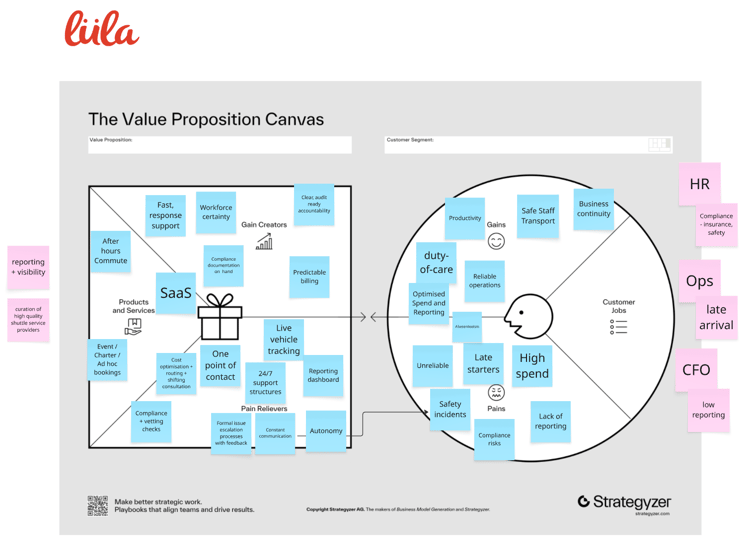
Here is how LULA's canvas resolved once the pairing discipline was applied:
|
Customer pain or job |
LULA's paired response |
What it is |
|---|---|---|
|
Staff arriving late, disrupting shift starts and production quota |
Ops leads stop phoning individual drivers to chase location - trips are monitored live and any issue is flagged and resolved before the shift starts |
Pain reliever |
|
Receiving an invoice at month-end with no record of what transport actually took place |
CFOs stop guessing - every trip is logged, spend is broken down by route and shift, and costs can be challenged or justified from a single report |
Pain reliever |
|
Compliance and insurance exposure if a driver has no clearance or is in an unroadworthy vehicle |
HR stops carrying the vetting burden - every driver partner has been police-cleared, PDPs checked and insurance verified before they ever touch a route |
Pain reliever |
|
Spending hours chasing multiple providers when something goes wrong mid-shift |
Operations teams stop managing a network of contacts - there is one number, one escalation process, and someone who owns the resolution |
Pain reliever |
|
Wants business continuity - shifts staffed, lines running, production targets met |
Workforce certainty: because drivers are vetted, monitored and backed by a 24/7 ops team, a skip or breakdown gets resolved, not just reported |
Gain creator |
|
Wants to demonstrate duty of care and show leadership that transport is under control |
Every trip is tracked, every driver is on record, and a compliance pack is ready when an auditor asks - the HR lead can show exactly what duty of care looks like in practice |
Gain creator |
The most valuable insight from the LULA example was that the company’s core value is not just software. It is also not just transport procurement. The deeper value is the combination of trusted supply, operational coordination, and visibility that gives customers a dependable one-stop solution.
In other words, the startup is not merely offering a dashboard. It is offering peace of mind.
That shift from describing functionality to naming the true customer value is exactly what the value proposition canvas is designed to uncover.
Your competition is not just the obvious competitor
Another workshop theme founders found useful was the need to define competition more honestly.
Too many startups limit competitive analysis to direct competitors that look similar on the surface. But customers compare you against whatever alternative they would realistically choose instead. That may include: manual workflows, internal teams, spreadsheets, informal vendors, existing service providers, fragmented tools, consulting substitutes, or doing nothing at all.
Elaine highlighted that “do nothing” is often the main competitor.
This is an especially important lesson for startups creating new behavior or introducing a category that buyers do not already understand. If a startup assumes the real battle is against a well-known competitor, it may miss the fact that the customer’s default behavior is inertia.
This came through in multiple examples:
- For Sparky AI, the true alternatives included doing nothing, YouTube, and classes—not just well-known language apps.
- For Riko AI, future comparisons may include generic AI tools, uploads into large language models, and other finance workflow products.
- For LULA, the comparison was not just against “other transport tech.” It included traditional shuttle providers, fragmented vendor management, and manual coordination.
Founders can map these alternatives using a simple 2x2 or criteria matrix based on what customers actually care about. The goal is not to prove you are better at everything. It is to identify the dimensions that matter most in a buying decision and explain how your approach differs there.
Geoffrey Moore’s Positioning Statement: A forcing function for clarity
Once founders have done the customer work and competitive thinking, they need a concise way to express the result. The workshop used Geoffrey Moore’s positioning statement, a classic framework that remains useful because it forces specificity.
The format is:
For [target customer] who [need], [product] is a [category] that [benefit]. Unlike [alternative], we [differentiation].
This is powerful because it prevents lazy messaging. Each part matters.
- For [target customer]
Not everyone. A specific audience. - Who [need]
Not a vague aspiration. A real and urgent problem or job. - [Product] is a [category]
Help the market understand what kind of solution this is. - That [benefit]
State the meaningful value created. - Unlike [alternative]
Name the comparison set honestly. - We [differentiation]
Show what makes your approach distinct and credible.
This is not only useful for websites and pitches. It is useful internally. If a team cannot complete this statement clearly, it usually means the underlying strategy still needs work.
LULA’s Positioning Statement
Using the workshop discussion, LULA’s refined positioning became much sharper.
A strong version would be:
For companies with shift-based workforces
that need safe, reliable, and cost-effective staff transport,
LULA is a tech-enabled staff transport management platform
that combines visibility with hands-on operational support,
unlike traditional shuttle providers or software-only solutions,
LULA brings together trusted operator networks, active service management, and real-time oversight in one coordinated solution.
Why does this work?
Because it tells us:
- who the customer is
- what problem they urgently face
- what category LULA belongs to
- what benefit it delivers
- and how it differs from the main alternatives
It also reflects the deeper truth identified in the value proposition canvas: LULA is not only selling transport logistics. It is selling reliability, accountability, and peace of mind.
The bigger takeaway: Positioning is a growth discipline
One of the best takeaways from Elaine Chen’s workshop is that strategic positioning is not separate from execution.
When founders get clear on who they serve, what pain matters most, and why their approach is different, they make better decisions across the business:
- product priorities become more coherent
- marketing messages become more resonant
- sales conversations become more efficient
- partnerships become easier to frame
- investor narratives become more convincing
A startup does not need the perfect sentence on day one. But it does need the discipline to keep refining until the message reflects the real customer problem, the real value delivered, and the real reason the company should win. And that is the power of strategic positioning.