

Practical go-to-market lessons from Rukaiya Rangwala for BonBillo's India and Southeast Asia Impact Accelerator cohort
The hardest GTM question is usually not “Which channel should we use?”
It is: What exactly are we asking the customer to value, and why should they act now?
During BonBillo’s Mumbai Immersion for the India and Southeast Asia Impact Accelerator cohort, Rukaiya Rangwala shared her GTM learnings across Marico, MobiKwik, Jabong, Rocket Internet and building her own startups. She worked 1-1 with our teams helping them prioritize GTM channels and sharpen how they price across markets. The goal was not to collect more channels, add more features or spend more on performance marketing.
The goal was to identify the specific customer, economic outcome and distribution path that could turn a promising product into a repeatable business.
Across senior care, spoken English, employee transport, battery intelligence, AI infrastructure, accounting and wealth management, the same pattern appeared again and again: strong startups do not win because they use every channel. They win because they understand where value is created, who feels it most urgently and how to reach that buyer efficiently.
1. Choose growth intensity based on the market
One of Rukaiya’s opening observations was simple but important: founders often hear conflicting advice about growth.
Some are told to be aggressive, spend quickly and capture market share. Others are told to protect margins, extend runway and wait for stronger unit economics. Both approaches can be correct. Neither should be followed blindly.
The right choice depends on three factors:
- The size and urgency of the market opportunity.
- The strength of the startup’s differentiation.
- The amount of capital and time available to prove the model.
For a consumer product such as a spoken English app, rapid experimentation across influencers, referrals and paid acquisition may be necessary to discover a scalable growth engine. For a deep-tech battery software company, however, scaling demand before proving degradation improvement and customer value can create more complexity than traction.
A useful founder question is not “Should we prioritize growth or profitability?” It is:
“What must we prove next, and what is the most capital-efficient way to prove it?”
2. Start with the economic pain, not the product description
Many founders describe what their product does. Buyers usually care about what changes after they adopt it.
Kubo Care, for example, uses radar and AI to monitor seniors without cameras or wearables. A product description might focus on fall detection, room exits, sleep analytics and anomaly detection.
But the stronger commercial story is about the operating and financial consequences for assisted-living providers:
- Fewer preventable falls and associated liability.
- More efficient deployment of nursing staff.
- Improved visibility into resident safety.
- A privacy-preserving alternative to camera-based monitoring.
That distinction changes the entire go-to-market strategy. Kubo Care is more likely to win with assisted-living operators, memory-care groups, consultants and care conferences than with broad consumer awareness campaigns.
The same principle appeared in LULA’s employee transport business. LULA does not simply provide vehicles and routes. Its customers are buying workforce certainty and peace of mind. Operations teams want fewer calls to chase drivers. Finance teams want predictable, understandable invoices. HR teams want reduced responsibility for driver vetting and employee safety.
When a startup identifies the economic pain behind the product request, its messaging becomes sharper and its buyer list becomes more precise.
3. The best channel is often already trusted by the buyer
Founders often approach go-to-market as a channel-selection exercise: paid ads, outbound sales, partnerships, content, events or influencers.
A better starting point is to ask:
“Who already has the customer’s attention and trust?”
For Kubo Care, consultants and industry conferences may be more valuable than generic digital campaigns because senior-care operators already rely on those networks when evaluating operational and safety solutions.
For LULA, facilities-management companies and manpower providers may be more effective than building a large enterprise sales team from scratch. These partners are already empaneled with major employers and understand the procurement process. A referral or revenue-sharing model could give LULA access to a larger market while reducing the time required to build every relationship independently.
For Crafters Wealth, the direct-equity portfolio intelligence platform, smaller brokers, wealth advisors, investment clubs and university communities may offer more credibility than expensive performance campaigns. In a category where trust, financial compliance and perceived expertise matter, education-led distribution can be more powerful than aggressive promotion.
Distribution is not only about reach. It is about borrowed credibility.
4. Partnerships work when they solve a partner problem too
Partnerships are often described as a shortcut to distribution. In practice, a partnership works only when the partner has a clear reason to participate.
LULA’s opportunity illustrates this well. A facilities-management or manpower partner may already serve large employers but lack a reliable technology-enabled transport solution. LULA can help the partner strengthen its offering, improve account value and reduce operational risk.
The partnership pitch should therefore not be “Please introduce us to your customers.”
It should be closer to:
“Together, we can help your customers manage employee transport more reliably, while creating a new revenue stream for you.”
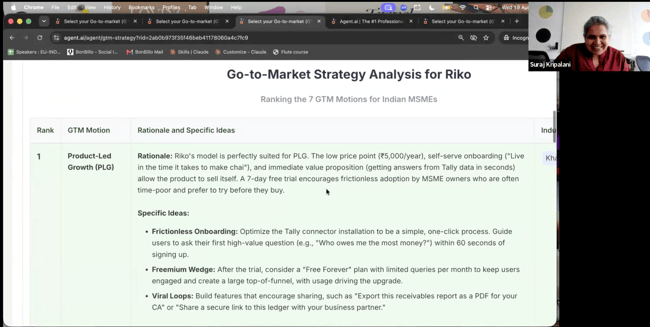
The same logic applies to accounting software. Riko AI already had relationships with Tally distributors, accounting firms and potential OEM partners. Those relationships are valuable because they connect the product to people who understand the workflow and can influence adoption.
Before pursuing a partnership, founders should answer four questions:
- What customer problem does the partner currently struggle to solve?
- How does our product improve the partner’s economics or customer retention?
- What effort will the partner need to invest?
- What evidence can we provide within the first 30 to 60 days?
5. Design pilots to produce a commercial decision
A pilot should not be an open-ended trial. It should answer whether the customer will pay, renew or expand.
Take for example Electica, the battery-life software company. Its technology can extend commercial battery life by approximately 25% without hardware changes. While the value may be realized over a longer period, customers naturally want proof before committing to a recurring fee.
A strong pilot structure could include:
- A short diagnostic period to establish the battery baseline.
- A paid pilot with agreed operational and degradation milestones.
- A clear definition of the evidence required for conversion.
- Pricing that reflects when the customer begins to receive measurable value.
The lesson extends beyond battery software. Whether the product is senior monitoring, enterprise AI or accounting automation, the pilot should be designed backward from the purchase decision.
Do not ask only, “Can the customer use the product?” Ask, “What evidence will make the next commercial step obvious?”
6. Consumer growth needs a system, not a single winning campaign
Sparky AI’s experience with spoken English shows why consumer startups must think beyond acquisition.
Influencer marketing and performance campaigns were effective because the product is easy to demonstrate and relevant to a large audience. But a healthy consumer growth model requires more than downloads or first purchases.
The next layer includes:
- Referral loops that encourage users to invite friends.
- Community features that make practice more consistent.
- Live sessions or coaching upsells that increase engagement.
- Certification or fluency badges that create an external reason to continue.
The practical takeaway is to separate the roles of each channel. One channel may create demand. Another may improve conversion. A third may strengthen retention. Treating every channel as if it must perform the same job leads to confusion.
A practical GTM checklist for founders
Before adding another channel or increasing spend, work through these questions:
- Customer: Who experiences the problem most urgently?
- Economic pain: What does the problem cost in money, time, risk or missed opportunity?
- Outcome: What measurable change does the customer receive?
- Trigger: What event causes the customer to search for a solution now?
- Trust: Who already influences the customer’s decision?
- Proof: What evidence is needed to move from interest to purchase?
- Partner value: If using partnerships, why does the partner benefit?
- Conversion: What must happen during the pilot or first 30 days?
- Economics: Can the channel produce sustainable contribution margin?
- Focus: What is the one GTM experiment that matters most this month?
This checklist is intentionally narrow. Early-stage founders rarely lack ideas. They usually lack the capacity to execute all of them well.
The bigger lesson: GTM is a sequence of decisions
The Mumbai workshop was not a search for one universal go-to-market playbook. The companies in the room operated across very different markets, geographies and business models.
Yet the strongest insights were remarkably consistent.
Kubo Care needed to quantify the value of privacy-preserving senior care monitoring. LULA needed to use partners to reach enterprise buyers more efficiently. Electica needed to connect pricing to the timing of battery-life savings. Sparky AI needed to build referral into its consumer engine. Crafters Wealth needed to earn trust before scaling promotion.
These are not isolated marketing problems. They are strategic positioning, customer discovery, business model and execution problems that happen to appear through the GTM function.
The question is not whether your startup has enough channels. The question is whether your best customer can clearly see why your solution matters now.