

Building a technology company is rarely just about developing a strong product.
Sometimes, the market does not yet understand the problem. Sometimes, customers need to change long-standing habits. Sometimes, the category exists - but the people who influence buying decisions are not the same people who use the product.
That is when the founder’s role expands. You are no longer only building technology. You are educating a market, creating trust, developing partnerships, shaping a category, and helping customers imagine a different future.
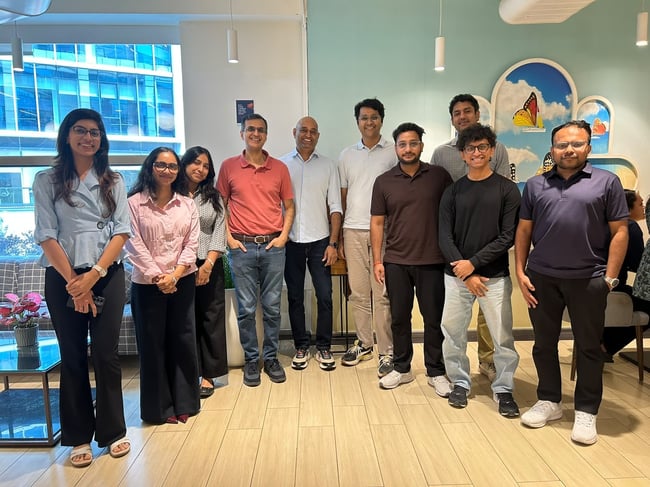
During BonBillo’s Bengaluru Immersion for the India and Southeast Asia Impact accelerator cohort, Mahesh Narayanan shared lessons from more than two decades of building and scaling technology businesses. His experience spans Google India, AdMob, Saavn, LinkedIn, and Netcore Cloud, along with four acquisitions, including AdMob’s acquisition by Google and Saavn’s acquisition by Reliance Jio.
Growth is not only a function of product quality. It is the result of making the product understandable, trusted, relevant, and valuable to the right people.
Market Creation Requires Education
When Mahesh joined Google India in 2005, the country had roughly 50 million internet users. Digital advertising was still unfamiliar to most businesses. Advertisers understood traditional media, but search advertising, display advertising, mobile advertising, and online video monetization were new concepts.
Google had to do more than sell advertising inventory. It had to educate advertisers on how search worked, why intent mattered, how digital campaigns could be measured, and why online channels deserved a place in the marketing budget.
The same pattern appeared later with mobile advertising, YouTube monetization, and audio streaming. Each new category required customers, agencies, and partners to learn new behaviors.
This is especially relevant for startups. A company building battery optimization software, continuous fertility monitoring, AI-powered accounting, or a voice-first English learning product may be solving a real problem - but the customer may not yet have a clear way to describe that problem.
Education can take many forms:
- Explaining the cost of maintaining the status quo.
- Showing customers how the new solution fits into existing workflows.
- Publishing data that makes an invisible problem visible.
- Using real customer stories to make the value concrete.
- Building simple tools, guides, workshops, or demonstrations.
New Categories Need New Partnerships
One of Mahesh’s key lessons was that entering a new category often requires building a different ecosystem around the product.
Search advertising and brand advertising, for example, involve different buying behaviors and different decision-makers. Search advertising is closely linked to performance and intent. Brand advertising depends more heavily on agencies, creative teams, media planners, and long-term brand objectives.
That meant Google could not rely on the same partnerships for every product. It had to understand who influenced the budget, how decisions were made, and what kind of proof each stakeholder needed.
For early-stage founders, this is a useful way to examine go-to-market strategy. Ask:
- Who experiences the problem?
- Who uses the product?
- Who approves the purchase?
- Who can block adoption?
- Who can accelerate trust?
For a deep-tech mobility company, the end user may be a fleet operator, but the buying process may also involve the chief technology officer, vehicle manufacturers, battery suppliers, regulators, and finance teams.
For a financial technology platform serving small and medium-sized businesses, the user may be an accountant, while the buyer may be a business owner and the trust validator may be an industry association or peer community.
Practical takeaway: Map the ecosystem - not just the customer. Category creation depends on relationships beyond the immediate buyer.
Differentiation Comes From Deeper Customer Understanding
In music streaming, the basic product can appear commoditized. The songs are often the same across platforms. That makes it difficult to compete through content alone.
Mahesh described how Saavn looked for differentiation beyond the catalog. The company invested in brand love, customer experience, independent music, podcasts, audio shows, and a stronger understanding of how people emotionally connected with music.
One important lesson was the value of listening directly to users. Social listening and customer meetups generated ideas that may not have emerged from internal product meetings - for example, features connected to how listeners actually used the service in their daily lives.
The broader point is simple: customer conversations should not be limited to the marketing team or customer support function. Product, data, engineering, and marketing teams should all hear users describe their needs in their own words.
Practical takeaway: Do not ask only, “What feature should we build?” Ask, “What does this problem feel like in the customer’s daily life?”
B2B Growth Is Built on Trust
For B2B startups, product demos are rarely enough. Customers need confidence that the company understands their industry, will support implementation, and will still be around when the product becomes mission-critical.
Mahesh emphasized the importance of testimonials, case studies, community, content, and relationships with industry bodies. These trust signals are particularly important when selling to conservative or highly regulated sectors.
A startup serving MSMEs and chartered accountants, for example, needs to demonstrate more than automation. It must show that its numbers are auditable, traceable, and aligned with established accounting practices. A deep-tech company selling into automotive fleets needs to demonstrate technical performance, operational reliability, and industry credibility.
This is why founders should think like content and media companies - not only product marketing teams.
Useful content can include:
- Industry benchmarks and market reports.
- Customer implementation stories.
- Practical guides for solving the problem manually.
- Expert discussions and roundtables.
- Data-backed perspectives on emerging trends.
- Educational content for partners and internal champions.
Thought leadership becomes even more powerful when created with trusted partners. Mahesh referenced reports such as AdMob’s mobile advertising research and the FICCI-KPMG media report as examples of how data, credibility, and distribution can reinforce one another.
Practical takeaway: Content should not merely announce what your product does. It should help the market understand why the problem matters and how the category is evolving.
Enterprise Sales Need Champions at Multiple Levels
Enterprise sales often begin with a senior executive, but they rarely succeed through one relationship alone.
Mahesh recommended building internal champions across the organization. A senior sponsor may open the door, but adoption usually depends on teams that will use, implement, evaluate, and defend the solution internally.
Peer proof can make a major difference. Customer presentations, industry mixers, roundtables, and carefully designed pilots can help prospects see how similar organizations are approaching the same challenge.
Pilots, however, need structure. Before starting one, founders and customers should agree on:
- The specific problem being tested.
- The baseline performance or current process.
- The expected outcomes.
- The timeline for evaluation.
- The decision criteria for moving forward.
A pilot without agreed outcomes can become an extended experiment with no clear path to conversion. A well-designed pilot creates evidence that helps the customer make an internal case for adoption.
For deep-tech and industrial startups, Mahesh also highlighted the value of senior industry advisors, experienced salespeople, and credible operators who can speak the customer’s language.
Practical takeaway: In enterprise sales, your goal is not just to win a buyer. It is to create a network of people who believe in the solution and can carry the case forward.
AI Adoption Is Also a Change-Management Challenge
Artificial intelligence is transforming how companies operate, but the biggest obstacle is not always technical.
Employees may resist AI because they fear losing their jobs, losing control over their work, or becoming less valuable. This is a human response to uncertainty, not necessarily opposition to innovation.
Mahesh compared the transition to earlier waves of technology adoption. The internet once created similar concerns and disruption. Over time, digital tools became a normal part of how businesses and people worked. AI is likely to follow a similar path, especially as AI-native generations enter the workforce.
For founders building AI products, this means adoption strategies should include:
- Showing how AI improves people’s work rather than simply replacing tasks.
- Creating transparent workflows and audit trails.
- Training users gradually through practical use cases.
- Giving teams visibility into how decisions are made.
- Measuring outcomes such as time saved, accuracy, and customer value.
The best AI companies will not only build intelligent systems. They will help organizations develop the confidence and capabilities to use those systems well.
Build for Value, Not for an Exit
Mahesh was direct about company exits: founders should not build a business primarily to be acquired.
His exit opportunities were not created by designing a company around a specific buyer. They emerged because the businesses were building differentiated products in valuable markets.
The right objective is to build a company with real value, strong fundamentals, and strategic optionality.
That means focusing on:
- A meaningful customer problem.
- A differentiated product.
- Strong retention and customer love.
- A scalable business model.
- Operational discipline.
- A team capable of executing over time.
An acquisition may eventually be one outcome, but it should not be the foundation of the strategy. Companies that create lasting value give themselves more choices - whether that means raising capital, becoming profitable, partnering, expanding internationally, or pursuing an exit.
Practical takeaway: Build a company that would be valuable even if no one acquired it. Optionality follows strength.
Culture Is the Company’s Unique Fingerprint
Technology, strategy, and capital matter - but the company’s culture determines how those resources are used.
Mahesh described culture as the cumulative personality of a company and its aspiration. It is shaped by the behaviors leaders reward, tolerate, model, and ignore.
Culture is not a sentence on a wall. It is visible in how teams make decisions, respond to mistakes, treat customers, handle disagreement, and support one another during difficult periods.
He also emphasized the importance of hiring people who are smarter than you. Strong founders do not need to be the best person in every function. They need to create an environment where talented people can do their best work.
For hybrid and remote companies, culture requires additional intention. Informal learning, watercooler conversations, and “learning by osmosis” do not happen automatically when people are distributed. Leaders need to create opportunities for connection, make their thinking visible, and invest in meaningful moments together.
There is no universal culture template. A company should not copy another organization’s culture wholesale. Culture is a company’s unique fingerprint, shaped by its mission, people, customers, and stage of growth.
Practical takeaway: Decide which behaviors your company needs to scale—and start rewarding those behaviors before growth makes them harder to establish.
The Opportunity for Startups
Companies that understand their customers deeply, explain their category clearly, build credible ecosystems, and create measurable outcomes are more likely to earn durable adoption.
Whether you are improving battery life, democratizing investing, automating accounting, expanding access to language learning, or transforming fertility care, the same principle applies:
Build something valuable. Help people understand it. Earn their trust. Then create the systems, partnerships, and culture that allow the value to scale.