

What would change if investing in women were not treated as a diversity initiative, but as a core growth strategy?
Across the world, women founders are building companies that respond to some of society’s most urgent challenges: access to healthcare, financial inclusion, climate resilience, education, mobility, energy, and community wellbeing. Yet many of these founders still face a funding environment that asks them to prove more, earlier, and with fewer resources.
That gap is not only unfair. It is economically inefficient.
During BonBillo’s Bengaluru Immersion for the India and Southeast Asia Impact Accelerator cohort, a fundraising conversation with Uthara Iyer at Colossa Ventures surfaced an important idea: the question is not whether women-led startups deserve investment. The question is how much innovation, market opportunity, and social progress the world is losing by failing to invest in them consistently.
Why women-led companies matter
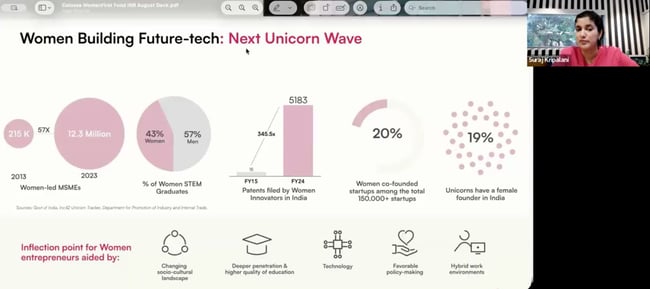
One of the most important themes from the session was the funding gap faced by women founders. Uthara shared that around 43% of STEM graduates in India are women, and patents filed by women have risen sharply. Male-founded and female-founded startups show similar success rates, and mixed-gender teams generate higher returns. Yet only about 2% of VC funding goes to women-only founding teams and around 10% to mixed teams. This gap is widest between seed and Series A, which is exactly where Colossa invests.
This is often discussed as a diversity or inclusion issue. It is certainly both. But it is also an investment issue.
When an entire group of capable founders receives less capital, fewer companies from that group have the opportunity to scale. That means investors may be overlooking strong businesses, underserved markets, and founders with valuable insights into customer problems. Investing in women is therefore not only about correcting an imbalance. It is about expanding the opportunity set. Women founders are building companies across consumer products, climate, healthcare, fintech, education, mobility and deep tech. Their perspectives can reveal market needs that have remained invisible or underdeveloped.
The case for investing in women should include fairness, representation and access, but it should also include performance. The session’s message was clear: this is an overlooked opportunity that can deliver the same, if not better, returns when the businesses are evaluated with the same rigor applied to every other investment.
For investors, that means questioning assumptions about who looks like a high-growth founder. For founders, it means recognizing that their experience and perspective can be a source of differentiation rather than something to minimize.
Women founders are not a single category, and their companies are not defined only by the gender of their leadership. They operate across industries, business models, and geographies. However, there are clear reasons why supporting women entrepreneurs is especially important for the ecosystem.
First, women are often close to the problems they are solving. They may have experienced gaps in healthcare, safety, education, financial access, caregiving, or employment firsthand. That proximity can create a sharper understanding of customer needs and a more grounded approach to product development.
Second, women-led startups frequently serve markets that have historically been overlooked or underestimated. These may include women consumers, rural communities, informal workers, caregivers, low-income households, or people whose needs are not reflected in traditional market research.
Third, the impact of investing in women often extends beyond one company. When women gain access to capital, networks, skills, and decision-making power, the benefits can reach families, employees, suppliers, and entire communities.
This is particularly relevant to startups aligned with the U.N. Sustainable Development Goals. A company working on clean energy, affordable healthcare, inclusive finance, or decent work can create direct impact through its product. But its leadership model can also influence who gets opportunities to build, own, and lead the next generation of solutions.
Fundraising is about more than a good idea
One of the most important lessons for founders is that investors rarely fund an idea in isolation. They invest in a combination of problem clarity, customer understanding, execution capability, market opportunity, and evidence that the team can learn quickly.
This is true for every founder, but it is especially important for women founders who are sometimes held to a higher bar.
A compelling fundraising story should answer five questions:
- What problem exists? Describe the problem in specific, human, and measurable terms.
- Who experiences it most intensely? Define the customer, not just the total addressable market.
- Why is your solution meaningfully better? Explain what changes for the customer after adopting it.
- What evidence do you have? Use revenue, retention, pilots, partnerships, user growth, testimonials, or other relevant proof points.
- Why is this team positioned to win? Connect the founders’ experience, insight, networks, and capabilities to the opportunity.
Impact founders sometimes make the mistake of leading with the size of the social problem. The problem is important, but investors also need to understand the business mechanics around it.
A strong pitch connects purpose and performance. It shows how solving a meaningful problem can also create a high-growth, scalable company.
The fundraising narrative: From mission to momentum
For founders, the most useful shift may be to stop treating the pitch deck as a collection of slides and start treating it as a narrative.
Your story should move the investor through a logical sequence:
1. The reality: Begin with what customers are experiencing today. Avoid abstract language. Show the cost of inaction, whether that cost is financial, environmental, social, or personal.
2. The insight: Explain what you understand that others have missed. Perhaps the existing solution is too expensive, too fragmented, difficult to access, or designed without the end user in mind.
3. The solution: Describe your product simply. If a founder cannot explain the product in one or two clear sentences, the investor may struggle to understand the business model behind it.
4. The proof: Show what has already happened. Early-stage proof does not always mean significant revenue. It can include strong customer demand, repeat usage, paid pilots, strategic partnerships, regulatory progress, or evidence that users are changing their behavior.
5. The opportunity: Explain why the company can become large enough to matter. A meaningful mission and a large market are not mutually exclusive. In many cases, the mission points directly to an underserved market with significant room for growth.
6. The next milestone: Investors want to know what their capital will unlock. Be precise about the amount you are raising, how it will be used, and which milestones you expect to reach.
This structure allows founders to communicate ambition without losing credibility. It also helps investors see how capital converts into progress.
The power of networks and warm introductions
Fundraising is often described as a numbers game: contact enough investors, take enough meetings, and eventually someone will say yes. In reality, fundraising is also a trust game.
Investors are making decisions with incomplete information. A trusted introduction can help reduce uncertainty by providing context about the founder, the market, and the reason the company deserves attention.
This does not mean that founders without extensive networks cannot raise capital. It means that building relationships should begin well before the fundraising round.
For founders, that can look like:
- Sharing thoughtful updates about customer learning and company progress.
- Building relationships with operators, mentors, accelerators, and other founders.
- Speaking with investors before actively raising to understand their thesis.
- Asking for feedback, not only money.
- Following up consistently after meetings.
- Creating a clear, easy-to-forward summary of the company.
Accelerator communities can play an important role here. They provide more than workshops and pitch practice. They create access to people who can challenge assumptions, open doors, share pattern recognition, and help founders prepare for conversations that may otherwise feel out of reach.
For women founders, these networks can be especially valuable because they counter the isolation that often comes with being underrepresented in venture-backed entrepreneurship.
Measure impact without losing the business
Impact founders are often expected to demonstrate both financial performance and social or environmental outcomes. That is appropriate, but it can become difficult when impact is described only through broad aspirations.
The strongest companies build measurement into the business from the beginning.
For example, a clean energy startup might track emissions avoided, energy access improved, and cost savings for customers. An inclusive finance company might measure new users served, repayment behavior, income stability, or access to formal financial products. A healthcare startup might monitor treatment adherence, wait times, affordability, or improved health outcomes.
The right metrics depend on the business. What matters is that they are:
- Relevant: connected to the problem the company exists to solve.
- Measurable: supported by a consistent method of collection.
- Comparable: useful for showing progress over time.
- Decision-oriented: capable of informing product, customer, or operational choices.
Investors do not expect every early-stage startup to have perfect data. They do expect founders to know what they are measuring, why it matters, and how the company plans to improve.
When impact metrics are connected to customer value and business performance, they become more than reporting requirements. They become part of the company’s competitive advantage.
What founders can do before their next investor meeting
Before beginning or restarting a fundraising process, founders can use the following checklist:
- Clarify the customer problem. Write down who has the problem, how often it occurs, and what they currently do about it.
- Choose three proof points. Select the strongest evidence of demand, traction, or learning. Do not overwhelm the pitch with every metric available.
- Explain the business model simply. State who pays, what they pay for, and why they continue paying.
- Connect impact to growth. Show how serving more customers also advances the company’s social or environmental mission.
- Map the capital to milestones. Explain what the next round of funding will make possible within a defined period.
- Research investors carefully. Understand their geography, stage, sector focus, portfolio, and approach to impact.
- Practice direct answers. Prepare for questions about competition, pricing, customer acquisition, team gaps, regulation, and risk.
- Build relationships early. Do not wait until the week before a raise to begin meeting potential investors.
Most importantly, remember that fundraising is not a referendum on your worth as a founder. A “no” may reflect timing, fund strategy, risk appetite, or lack of understanding - not the ultimate potential of your company.
A more inclusive future requires more than encouragement
There is no shortage of conversations about supporting women entrepreneurs. What is needed now is more consistent action.
That means investors examining whether their sourcing practices reach women founders. It means accelerators creating access to capital, mentors, and customers. It means corporations becoming early customers of innovative startups. It means ecosystem leaders making room for founders from different backgrounds, geographies, and lived experiences.
It also means women founders being supported beyond symbolic visibility. Encouragement matters, but access matters more. Access to capital. Access to decision-makers. Access to technical expertise. Access to trusted networks. Access to the opportunity to build companies at meaningful scale.
The investment we cannot afford to miss
Investing in women is not only about correcting an imbalance in the past. It is about identifying the builders of the future.
Women founders are creating solutions for markets that are growing, urgent, and often underserved. They are developing businesses aligned with the Sustainable Development Goals while navigating complex realities with creativity and resilience.
The opportunity for investors is clear: look beyond familiar patterns, widen the networks through which opportunities are discovered, and evaluate companies based on evidence rather than assumptions.
For founders, the opportunity is equally clear: make the problem specific, make the business model understandable, make the evidence visible, and make the path to impact credible.
When we invest in women with conviction, we do more than support individual entrepreneurs. We expand the range of problems that get solved, the communities that get served, and the futures that become possible.
The future of impact will not be built by one type of founder. It will be built when more women have the capital, networks, and opportunity to lead.