

As a founder, you're probably treating fundraising as a pitch problem. Polish the deck, nail the story, get in front of enough investors, and the money shows up. Right?
Here's the hard truth: the deck is the smallest part of it. Investors are judging how fast you answer their emails, whether you've picked a niche you can actually win, and whether you're asking for money to hit a real milestone or just to survive the next 6 months.
That's the picture Arjun Rao, Founding Partner at Speciale Invest, painted for our founders during BonBillo's Bengaluru Immersion. A former founder who's spent about a decade investing, Arjun backs deep science and tech startups, often when it's "two founders and a story." His reason for starting the fund is a good place to begin. India had already built the Uber, Amazon, and PayPal of India, but not a Google or Nvidia from India. In his view that wasn't for lack of talent. It was for lack of patient, risk-taking capital.
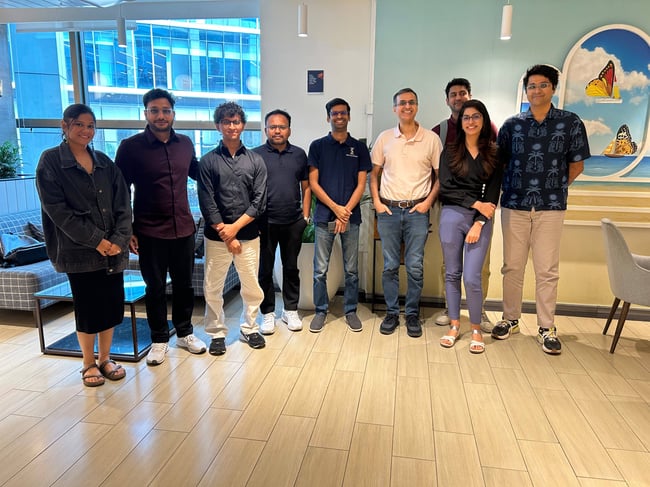
Here's what we took away from a candid conversation.
First, Know Who You're Pitching
Speciale writes $0.5M to $1.5M checks to lead pre-seed and seed rounds of $1M to $2M. It invests only in B2B, and only where the IP is hard to replicate. It's made about 50 investments across three funds. The funnel is brutal:
|
Stage |
Deals per year |
What happens |
|
Inbound |
3,000-4,000 |
Every deck gets looked at; most get a quick no |
|
Some attention |
~300 |
1-3 meetings over 10-15 days to check nothing's being missed |
|
Serious attention |
25-40 |
Multiple meetings, iterations, prep for investment committee |
|
Invested |
5-10 |
A leap of faith on a handful |
Notice how long this takes and how many good companies drop out. Getting through takes 1 to 6 months, with a median of 3-4. With unlimited money, Arjun said, they'd do 30 deals a year. They've also had a year with zero deals because nobody hit the bar.
The 4 Things Arjun Is Really Evaluating
When a company is pre-revenue and often pre-product, there's not much to diligence except you. Here's what he probes for.
- Your unique insight: What do you know that very few other people do, and how did you get there? "It can be a few months and not a few years, but in those few months, what have you done differently?" Who did you talk to, and how has your hypothesis changed?
- A 10x delta, not a 2x one: "There is no point of making something 20% better, 40% better, 60% better, 100% better," Arjun said, "because in today's world, people catch up." You need to be 5x, 7x, or 10x better on cost, speed, or revenue. Then attach a North Star metric to it.
- A moat that holds for 24-36 months: "There are no markets without competition," he said. Assume someone's working on it. The only question is whether it's 5 people or 500. In AI especially, he asks, "Why will an open source model or one of the premium models not be able to do what you're doing tomorrow?" Data moats count, but only if you can explain why you have the data and others don't. His benchmark: "Somebody takes a year, you take a month. That is meaningful."
- A market with velocity, not just size: Saying you only need 1% of a $100 billion market sounds great until you realize that market also attracts giants and a hundred other startups. Arjun is fine with small markets as long as there's velocity, which he defines as desperation plus willingness to pay. Big market, long queue. Small market, open door.
If a customer has 10 alternatives, "you're standing in line outside their door saying, try me too. That's not fun." You want to be where "the queue is shut."
Putting It Into Practice: Narrowing the Niche
Do the customer's math. A battery-tech founder explained that they extend the life of large battery packs without any hardware changes, and that they focus on electric bus and commercial fleets. Arjun pushed him to pick one category, because a three-wheeler fleet and a trucking fleet have totally different unit economics. His rule of thumb: save a customer 10 rupees and they'll give you 1. The founder's numbers checked out:
|
What Arjun asked |
The founder's answer |
The lesson |
|
What does the asset cost? |
An electric bus runs about ₹1.7 crore |
Know the customer's biggest line item |
|
What do you save them? |
Roughly ₹40 lakh over 10 years |
Frame value as lower Total Cost of Ownership |
|
What do you charge? |
About ₹2.4 lakh |
Well inside the 10:1 rule, with room to grow |
Raise to Kill Risks, Not to Buy Time
Arjun frames every round with one question: are you raising to build, to validate a hypothesis, or to scale? Then list the risks an investor sees (product, market, competition, go-to-market) and say which ones this round removes. Tackling risks one and two now and three and four at Series A is a plan. "I'm raising money for 6 months" is "not a good place to be."
The next investor will check what you did with this money. Deliver most of what you promised and you're fine. Deliver one thing out of six and that's execution risk.
No revenue yet? Large customers giving you their time is the next best thing. "A lot of people can talk, but when they act, that is the real validation." A big company that puts two of its people on integrating your product is paying you, just not in cash.
Run It Like an Enterprise Sale
Find the lead. "A high conviction lead investor is 80% of fundraising." A fund writing $100-150K checks can say yes fast and build momentum. But it'll tell you to go find a lead, because it won't set the price.
Match fund size to check size. A $1-2M check from a $50-100M fund is serious. A $500K check from a billion-dollar fund is "a call option for them." Check each fund's last 5-10 deals, and find the partner who knows your domain. At Speciale, convincing climate specialist Vishnu beats convincing someone who then has to convince Vishnu.
Build the pipeline. Keep a CRM of 30-50 funds, priority ranked by check size, fund size, expertise, and brand. Start with a 10-day "dipstick": pitch 5 friendly VCs to sharpen the story. Then run a focused 3-month process with one founder on it nearly full-time. Within 3-4 weeks you should know your top 5. Use the next month to get offers from the top 3.
Drop the fast nos. "You don't want to spend time and effort on converting a non-believer." Find the semi-believers. You only need one convert on the lead check.
Aim low, then upsize. If you could do with $2-2.5M but ask for $4-5M, you've just taken every $2M lead off the table. Remember, "their excess choice is your problem." Start conservative. If two or three investors compete, a $2M round can become $3M.
Answer fast. Investors track your response rate. Aim for 24 hours, 48 at worst. It's fine not to know an answer. "The point is, how quickly do you come back with an answer." Arjun admitted he loves that kind of founder: "We want the best technology, but we also want the most hustled founder."
Skip the games. One founder asked whether to play hard to get. Arjun's answer: "Straightforward is the best." This is a 5-7 year relationship, and the industry is tiny. If you claim another fund is super interested, "trust me, I will find out in the next half an hour." Save any competitive pressure for the final five, and only if it's true.
Push the slow ones. Some VCs just want to learn. If someone keeps asking for "one more meeting," ask when you'll reach a partner and the investment committee. Arjun said that if a "priority" deal sits with one person for three or four weeks in Speciale's Monday call, he wants to know why.
Valuation: Stop Overthinking It
Arjun was refreshingly blunt here. Don't put a valuation or dilution number in your deck, just the amount you're raising. At the early stage, "our valuation numbers come from our fund math," and they are "not a reflection of what you folks are worth." Speciale aims for about 15% ownership, give or take 5. Across stages, median rounds in India dilute 20-30%.
Negotiate within a range: ask for 1.2x the money, or offer 0.8x the equity. Want a much bigger number? "You better have four offers."
And don't lean on a vanity price. His example: an angel worth ₹10,000 crore writes a ₹1 crore check for 1%. That doesn't make you a ₹100 crore company.
Also weigh reserves. A micro VC may take less ownership but is often one and done, while a fund like his can follow on: "if I put a million now, I can put 2 million next round." The tough times are exactly when you'll want investors who are already biased toward you.
On financial projections, he cares about the assumptions, not the revenue line. If you say you'll close a customer in 3 months, expect "half a dozen questions" about why it won't be 6 or 9. "The plan may fail," he said, but not having one is worse.
Your 5-Step Fundraising Action Plan
- Write down your 10x number: the improvement you deliver for one customer type, with the math.
- Cut to one niche: the segment in your own customer mix with the sharpest shared pain.
- List the risks this round removes: 2-3 of them, each tied to a milestone.
- Build a 30-50 fund CRM: check recent deals, find the right partner, rank P0 to P2.
- Book a 10-day dipstick with 5 friendly VCs: then launch the full process, with a 24-hour reply rule.
One Believer Is Enough
The way Arjun describes it, fundraising is an enterprise sale with a 7-year contract at the end, and the buyer is judging your follow-through as much as your technology. Narrow the niche, remove the right risks, and run the process like you mean it.
Then remember what he told the room near the end: "You can get 99 no's, it doesn't matter." One believer gets you off the ground. The rest is patience and a thick skin.