
From Mission to Metrics: A Founder's Guide to Building a Theory of Change
How to turn your startup's good intentions into a measurable, fundable impact story?
As a founder, you're driven by a vision to solve a real-world problem. You see a gap in the market, a community in need, or a system that's broken, and you're building the solution. But in the whirlwind of product development, customer acquisition, and fundraising, a critical question often gets pushed aside: How do you prove you're actually making a difference?
It's a question that's becoming increasingly important. We're in an era where "impact" is more than just a buzzword. Investors, customers, and top talent are all looking for more than just a healthy bottom line; they're looking for a clear, credible story of change. This is where many impact-driven startups stumble. They have a powerful mission but struggle to connect their day-to-day activities to the long-term change they aim to create. The result? A vague impact narrative that fails to inspire confidence or attract capital.
The solution is more structure. You need a roadmap. This is where the Theory of Change (ToC) comes in. It's a powerful framework that helps you articulate the logical sequence of events that links your startup's actions to its ultimate impact. For an early-stage startup, it's a strategic compass for decision-making, a communication asset for impact fundraising, and a blueprint for building a business where impact and profit grow hand-in-hand.
In this guide, we'll break down what a Theory of Change is, why it's essential for your startup, and walk through a real-world example from BonBillo alumnus PriyoShop. We'll also show you how you can leverage AI to build your own ToC in minutes, not weeks.
What is a Theory of Change?
At its core, a Theory of Change is a comprehensive description and illustration of how and why a desired change is expected to happen in a particular context. It maps out the causal pathway from your daily work to the long-term goals you want to achieve. As Yaquta Fatehi, an Impact Assessment Professional at the William Davidson Institute, explained in a session with our BonBillo community, the framework creates a clear, logical chain: your Activities lead to tangible Outputs, which in turn create measurable Outcomes (changes in behavior, knowledge, or conditions), and over time, these outcomes contribute to a larger, long-term Impact.
Think of it as your startup's "if-then" statement: If we perform these specific activities, then we will produce these direct outputs, which will lead to these short- and long-term outcomes, ultimately contributing to our desired societal impact.
This isn't just an academic exercise. A well-defined ToC helps you:
- Gain Strategic Clarity: It forces you to be specific about what you're trying to achieve and how you'll get there, helping you prioritize resources and say "no" to distractions.
- Communicate with Stakeholders: It provides a simple, powerful narrative to explain your value to investors, partners, and customers.
- Measure What Matters: It helps you identify the key metrics (indicators) you need to track to prove you're making progress.
- Fundraise Effectively: It shows investors that you're not just mission-driven, but also disciplined, strategic, and accountable.
Deconstructing the Theory of Change: The Building Blocks
A robust Theory of Change is built on a clear hierarchy. Let's break down the components, using the framework we teach at BonBillo.
The ToC Framework
| Component | What It Is | Key Question |
|---|---|---|
| Programs | The 3-5 core workstreams or pillars of your startup that connect your mission to long-term change. | What are our main areas of work? |
| Activities | The concrete, operational actions your team performs daily. | What do we do? |
| Outputs | The direct, tangible, and factual results of your activities. These are completion-based and do not reflect changes in mindset or behavior. | What gets done? |
| Outcomes | The changes in knowledge, skills, attitudes, behaviors, or conditions that result from your outputs. These are broken down into short, medium, and long-term. | What changes for our users? |
| Impact | The deeper, long-term (10+ years) societal change your startup contributes to, aligned with your mission and relevant SDGs. | So what? What is the ultimate change we are contributing to? |
Bringing It to Life: PriyoShop's Theory of Change in Action
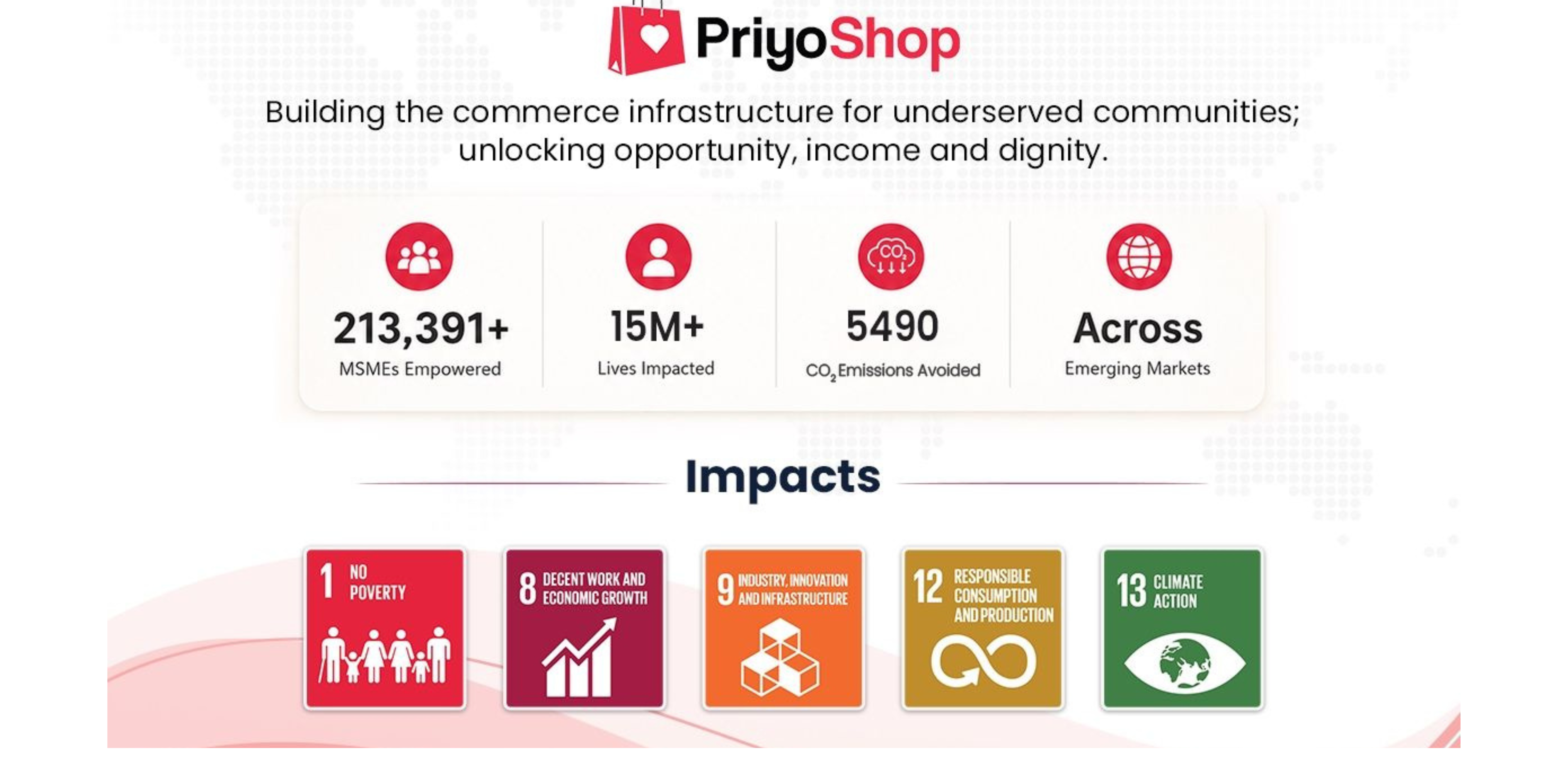
Theory is great, but let's make this concrete. PriyoShop is a B2B marketplace in Bangladesh that empowers over 213,391 micro, small, and medium-sized enterprise (MSME) retailers. They connect these small shop owners directly to suppliers, provide embedded financing, and focus on sustainable last-mile delivery. Their mission is ambitious, but their Theory of Change breaks it down into a clear, logical, and measurable plan.
PriyoShop's Impact at a Glance
| Metric | Impact Number |
|---|---|
| MSME retailers empowered | 213,391 |
| Working Capital Disbursed | $3.93M |
| % increase in monthly revenue per MSME | 51% |
| Credit Beneficiaries | 12,000+ |
| Active Delivery Routes | 1,474 |
| EV Deliveries | 41% |
| Solar-Powered Hubs | 45% |
| Cumulative reduction in CO2 emissions | 5,490 Metric Tons |
| Fuel Cost Saved per Delivery | $0.40 |
Let's walk through how their core programs connect daily actions to long-term impact.
Program 1: B2B Marketplace
This is PriyoShop's core offering, designed to digitize the fragmented and inefficient supply chain for small retailers.
- Activities: The team focuses on two key actions: onboarding FMCG brands and suppliers to the platform, and establishing last-mile distribution routes across Bangladesh.
- Outputs (The "What Gets Done"): These activities result in tangible, measurable outputs: brands and suppliers are registered, and distribution routes become active.
- Output Indicators: To track this, they measure the # of brands/suppliers onboarded (currently 296) and the # of active delivery routes (currently 1,474). These are simple, factual metrics that show the platform is growing.
- Short-Term Outcomes (The Immediate Change): Once the marketplace is active, MSMEs experience immediate benefits. They gain access to a wider range of products and, for many, their first line of formal credit. This is measured by the % increase in average SKUs ordered per MSME (currently 23%).
- Medium-Term Outcomes: With better access and credit, retailers improve their purchasing power and inventory management. This leads to larger, more strategic orders, tracked by the % increase in average order value per MSME (currently 12%).
See the logic? The activity of onboarding suppliers leads to the output of a populated marketplace, which results in the outcome of retailers ordering more diverse products and increasing their order sizes.
Program 2: Embedded Finance
A major pain point for MSMEs is access to working capital. PriyoShop addresses this by embedding financial services directly into their platform.
- Activities: This involves integrating AI credit scoring models with banking partners and disbursing micro-loans and credit lines to retailers.
- Outputs: The direct results are integrated credit models and disbursed credit lines.
- Output Indicators: Progress is measured by the # of financial partnerships established (currently 13) and the Total value ($) of credit disbursed (currently $3.93M).
- Long-Term Outcomes: Over time, this access to capital leads to reduced procurement costs and increased retail sales for the MSMEs. This is where the real business impact becomes visible, measured by the % increase in monthly revenue per MSME (currently 51%) and, crucially for investors, the % of customers who secured loans through PriyoShop's intervention (currently 12,000+).
Here, the availability of credit (output) directly empowers retailers to grow their revenue (outcome), creating a more resilient and profitable business.
Program 3: Sustainability
PriyoShop is building a sustainable logistics ecosystem to drive both efficiency and environmental benefits.
- Activities: Increase the number of EV deliveries and increase the number of solar-powered distribution hubs.
- Outputs: A greener logistics network with a higher percentage of clean energy usage.
- Output Indicators: They track this with metrics like % of EV deliveries (currently 41%) and % of solar powered hubs (currently 45%).
- Long-Term Outcomes: The combined effect of more efficient logistics and sustainable practices contributes to both operational savings and environmental benefits. Key outcomes include Fuel cost saved per delivery ($0.40) and the Cumulative reduction in CO2 emissions (currently 5,490 Metric Tons).
Tying It All Together: The Long-Term Impact
When you combine the outcomes from all three programs, you get a powerful, compounding effect. Retailers who have a user-friendly app (Digitalization), access to a wide range of products (Marketplace), and the capital to purchase them (Finance) can sell more, all while being served by an efficient and sustainable logistics network. This leads directly to PriyoShop's overarching Long-Term Impact Statement:
"To become the digital backbone of Bangladesh's retail economy, empowering MSMEs with seamless access to products, financing, and growth opportunities."
This is the logical conclusion of their entire Theory of Change. They can point to every activity, output, and outcome as a building block toward this goal. Finally, they align this impact with the U.N. Sustainable Development Goals (SDGs), focusing on the top 2-3 that are most relevant:
- SDG 8: Decent Work & Economic Growth (by supporting MSME formalization and growth)
- SDG 9: Industry, Innovation & Infrastructure (by increasing access to financial services and building sustainable infrastructure)
- SDG 10: Reduced Inequalities (by ensuring income growth for the bottom 40% of the population)
The AI Co-Pilot: Craft Your Theory of Change in Minutes
Reading through PriyoShop's example, you can see the power of a well-structured ToC. But as a founder, you're probably thinking, "This looks great, but I don't have weeks to spend on a strategic framework."
You don't have to. We recognized this was a major roadblock for early-stage founders, so we built an AI tool to do the heavy lifting. At BonBillo, our startups use the Craft your Theory of Change AI agent to turn this exercise into a simple, interactive process.
Your Mission, Measured
A powerful mission is the heart of any great impact startup. But a clear, measurable Theory of Change is its backbone. It provides the structure, discipline, and credibility you need to attract investment, align your team, and prove that you're not just building a company—you're building a better future.
Your impact story is too important to be left to chance. It's time to move from vague intentions to a clear, fundable plan.
Ready to map your own path from action to impact? Try BonBillo's "Craft your Theory of Change" AI agent today and turn your mission into a story that investors can't ignore.