
A startup can create jobs, attract capital, and become a profitable company with a meaningful impact. But before any of that happens, founders could spend years navigating uncertainty, imperfect markets, changing business models, difficult hiring decisions, and questions that rarely have straightforward answers.
During BonBillo’s India and Southeast Asia Impact Accelerator, Roli Gupta shared a candid account of her founder journey. From building a solar company in India to creating an AI-powered recruitment platform, her story offered lessons on founder-market fit, cofounder relationships, regulated sectors, and the practical realities of using AI to improve hiring.
Her central message was simple: building a company is a long game. Founders need to choose problems they genuinely care about, stay close to customers, and give good businesses enough time to compound.
Start with work you genuinely enjoy
Roli’s professional journey began at IIT Bombay and included a decade in the United States, where she worked across oil and gas, finance, and software product management. Her first role was at Schlumberger, but over time she felt increasingly drawn toward renewable energy.
That shift was not only about market opportunity. It was about mission alignment. Roli believed founders should spend time working in areas they genuinely enjoy because the startup journey will almost always take longer than expected.
That distinction matters. A sector may look attractive from the outside, but building a company requires sustained interest in the underlying problem. Founders spend years speaking with customers, hiring teams, handling operational setbacks, adjusting pricing, and explaining the same vision repeatedly. If the work itself does not hold your attention, the difficult periods become much harder to navigate.
In solar, financing was not the first problem
In 2014, Roli co-founded Oorjan, a company focused initially on residential distributed solar. The early business explored marketplace and financing models, including an initiative using Priority Sector Lending for solar loans.
At first glance, financing appeared to be one of the biggest barriers to solar adoption. If households could access loans, more customers might install solar systems. But customer conversations revealed a more fundamental challenge.
People still had basic questions:
- Can I trust the technology?
- Will the system work reliably?
- How does the subsidy process work?
- Is solar right for my home and electricity usage?
- Who will install and maintain the system?
The lesson was clear: financing alone could not solve a trust and education problem. Oorjan eventually shifted toward a full-stack EPC model with embedded financing, addressing more of the customer journey instead of focusing on capital access in isolation.
The right business for the company may not be the right business for every founder
Roli eventually left Oorjan after about five years. When she exited, Oorjan had a validated business model and was generating approximately ₹15 crore in revenue. It has since gone on to scale significantly, became profitable, expanded to more than 100 employees, and entered areas such as commercial solar, open access, batteries, and data centers.
Roli recognized that the company had become increasingly project-management oriented. That direction no longer excited and challenged her, but fit well with her co-founder, Gautam Das. Leaving allowed the business to continue under leadership aligned with its next phase, and gave Roli the space to explore leveraging technology to solve a large problem.
This is an important takeaway for founders: a company can be doing well even when the role no longer fits one of its founders.
Founder-market fit can change over time. The skills and energy required to launch a company may be different from those needed to scale a large operational business. Recognizing that shift requires honesty, not only ambition.
Regulated markets reward persistence
Roli’s experience in solar also highlighted how long it can take for a regulated market to mature. Policy, subsidies, infrastructure, customer awareness, financing, technology costs, and industry capabilities all influence adoption.
In sectors such as renewable energy, batteries, electric vehicle charging, and data centers, progress rarely follows a straight line. Market conditions may look promising, but regulatory changes or infrastructure constraints can slow adoption. Customers may take time to build confidence. Business models often evolve several times before reaching scale.
Roli’s story suggests that founders should avoid judging a promising company too early. In regulated and infrastructure-heavy markets, it can take a few years for the full opportunity to emerge.
Staying in the game long enough creates compounding value. Relationships deepen, operational knowledge accumulates, customer trust grows, and the company becomes better positioned when the market finally accelerates.
Co-founder relationships need structure, not just trust
One of Roli’s strongest pieces of advice was to have difficult co-founder conversations early. Founders should establish clear agreements around roles, vesting, ownership, decision-making, management responsibilities, and possible exit scenarios.
Many founding teams begin with a high level of trust and shared excitement. That is valuable, but it is not a substitute for clarity. A company’s needs will change. Founders may disagree about strategy, personal circumstances may evolve, and one person may want to leave while another wants to continue.
These conversations can feel uncomfortable at the beginning, but they are much harder after conflict emerges. Founders should work with lawyers early to create agreements that address both ordinary operations and unexpected scenarios. Clear documentation protects relationships because it reduces the need to rely on memory or assumptions later.
Thankfully, Roli and her co-founder had strong relationship and structured agreements in place, leading to her smooth transition.
Founder decompression can reveal the next problem to solve
After leaving Oorjan, Roli took approximately 12 months to decompress from the intensity of building a company. This period gave her time to reflect on what she wanted to do next.
Rather than immediately starting another company, she observed problems around her. One issue stood out: hiring was broken, especially for companies recruiting at high volume.
Roli saw organizations spending significant time and money searching for candidates, only to receive a small number of qualified prospects. In some hiring processes, the effective signal could be as low as two useful candidates out of every 100 profiles reviewed.
Conversations with founders reinforced the scale of the problem. Companies hiring hundreds of salespeople each month could not depend entirely on referrals, personal networks, or manual screening. They needed a repeatable way to improve the quality of the top of the recruitment funnel.
This insight led to Babblebots, an AI-powered recruitment platform designed to improve the signal-to-noise ratio in hiring.
AI should improve the funnel, not replace judgment
Babblebots focuses on top-of-funnel recruitment. Its workflow includes talent discovery, outreach, screening, phone and video interviews, and coding assessments.
A recruiter or hiring manager can upload or dictate a job description. The system helps generate criteria, search a large candidate database, and apply filters such as skills, location, experience, and must-have requirements. Teams can then view profiles, send bulk emails, make calls, or trigger AI screening conversations.
The goal is to move from finding two relevant candidates out of 100 profiles to finding two out of 20. That does not eliminate the need for human judgment. Instead, it allows hiring teams to spend more time evaluating serious candidates and less time sorting through weak matches.
The broader principle applies beyond recruitment: good AI products should reduce repetitive work while keeping important decisions visible and accountable to people.
Measure the funnel, not just the final outcome
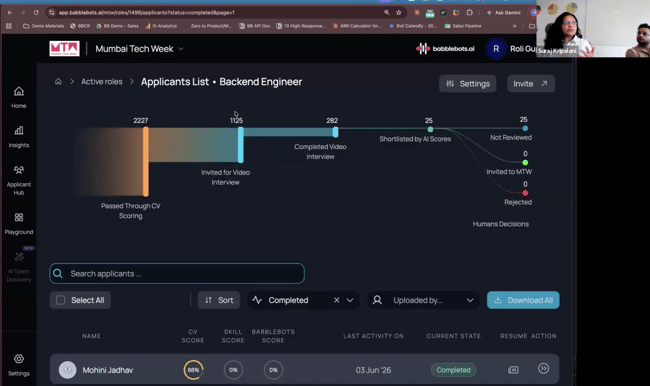
One example from Mumbai Tech Week showed how recruitment signal can be improved through multiple stages. From approximately 2,200 applicants:
- About 1,100 people were invited after CV and profile matching.
- Approximately 280 completed AI video interviews.
- About 25 candidates were identified as qualified.
The final qualified signal represented roughly 1% of the original applicant pool. Rather than treating the process as one large, undifferentiated list, the funnel helped the team understand where candidates were being filtered and where further attention was needed.
Early-stage hiring is still deeply human
For a startup’s first 10 to 15 hires, recruitment is often bespoke. Founders rely on personal networks, referrals, gut instinct, culture fit, and trust built through direct conversations. This is understandable: early employees shape the company’s working norms and often carry significant responsibility.
As the company grows, however, informal hiring methods become harder to scale. Recruitment agencies may be expensive, internal teams may be stretched, and founders may not have enough time to review every candidate carefully.
Roli emphasized that the value of better talent acquisition is speed and quality: finding stronger candidates faster, reducing delays in critical roles, and improving the likelihood that new hires will succeed.
Trial projects can sometimes help assess capability, but they can also fail when candidates and companies have different expectations about commitment. The hiring process must therefore evaluate both skills and intent.
Five takeaways for founders
- Choose a problem you can stay committed to. Startup journeys are longer than expected, so genuine interest matters.
- Validate the full customer problem. Financing may not solve a trust, education, or implementation challenge.
- Recognize when founder-market fit changes. Leaving a successful company can be the right decision when the next phase requires a different kind of leadership.
- Put co-founder agreements in writing. Discuss ownership, roles, vesting, management, and exits before conflict makes those conversations harder.
- Use AI to improve decisions, not obscure them. Automation should reduce repetitive work while preserving human accountability.
Scaling a startup requires patience and persistence
The most useful founder mindset may be disciplined persistence: staying close to the problem, learning from evidence, changing direction when necessary, and remaining patient when a meaningful market takes time to develop.
That is the long game. It is not always easy to see daily progress, but the right decisions compound over years.